Best Place to Bet on UFC in the UK: Sportsbook Rankings and Markets Guide 2026
 Available in US
Table of Contents
- The Short Answer on UK UFC Betting
- What Separates a Good UK UFC Sportsbook From a Mediocre One
- Reading UFC Prices the British Way
- The UFC Markets That Actually Matter on a UK Sportsbook
- In-Play, Bet Builder and Cash Out: Where the UK Toolkit Earns Its Keep
- The 2025 Regulatory Reset and What It Changed for UFC Punters
- Integrity, the Dulgarian Precedent, and Why Refunds Reveal Character
- Watching What You Bet On: UFC Broadcast in the UK
- A Strategy Primer Grounded in Actual UFC Outcome Data
- Betting Within Limits: The Responsible-Play Layer
- Questions UK UFC Punters Keep Asking
- A Scoreboard, Not a Podium
Sharper UFC markets. UKGC-licensed bookmakers. One scoreboard.

I have been pricing UFC cards for UK punters for a decade, and I will tell you now that the question in the headline — where is the best place to bet on UFC in the UK — does not have a single brand-shaped answer. It has about six of them, and which one is “best” for you depends on whether you are hunting for the sharpest moneyline, the deepest Bet Builder, a streaming feed inside the app, or simply the book that pays underdogs without a fuss when a fight is refunded for integrity reasons.
This is the fight-night scoreboard I wish someone had handed me when I started: independent, numbers-first, UK-first. You will get the market landscape as it stands in 2026, a plain-English read on UKGC rules after the 2025 reforms, the odds maths every UK punter should have in their head, and a strategy primer grounded in actual UFC outcome data rather than pundit gut.
UK online GGY FY 2024–25
£7.8 billion, up 13.1% year on year — the fastest-growing slice of the UK betting market.
In-play on mobile
74% of UK in-play bets are placed on a phone or tablet. Fight nights lean even harder that way.
Underdog win rate
Roughly 30–35% of UFC underdogs cash — enough to matter, not enough to bet blindly.
One ground rule. I rank operators by market depth, pricing discipline, cash-out fairness, live-feed latency, and how they handle the unglamorous bits — verification, withdrawals, refunds when a fight goes sideways. A book that nails the glamour and falls over on the admin is not the best place for anything.
The Short Answer on UK UFC Betting
- The UK online betting market reached £7.8 billion GGY in the year to March 2025, and UFC markets on UKGC-licensed books are priced with typical moneyline margins of 4–7% on main events, wider on props.
- The 2025 reforms — £5 and £2 online slots stake limits and a statutory 0.1–1.1% gambling levy — apply to operators, not to sportsbook UFC markets directly. Your UFC stake is uncapped by statute.
- Winnings from UFC bets are tax-free for UK residents. Operators pay point-of-consumption duty, not you.
- Integrity matters more than bonuses. The November 2025 Dulgarian refund cycle showed which books grade suspicious cards cleanly and which drag their feet.
- For sharper pricing, line-shop across two UKGC books, and keep 74% of your action on mobile where in-play odds update fastest.
What Separates a Good UK UFC Sportsbook From a Mediocre One
A few years back a reader emailed me a screenshot of six tabs, all UK UFC markets on the same main event, spread across six sportsbooks. The moneyline on one fighter moved from 4/6 to 8/11 to 4/5 across the six. Same fight. Same night. A £100 stake paid out £66, £72.70, or £80 depending on which tab he clicked. That is why line-shopping is not a nice-to-have for UK UFC punters — it is the whole game.
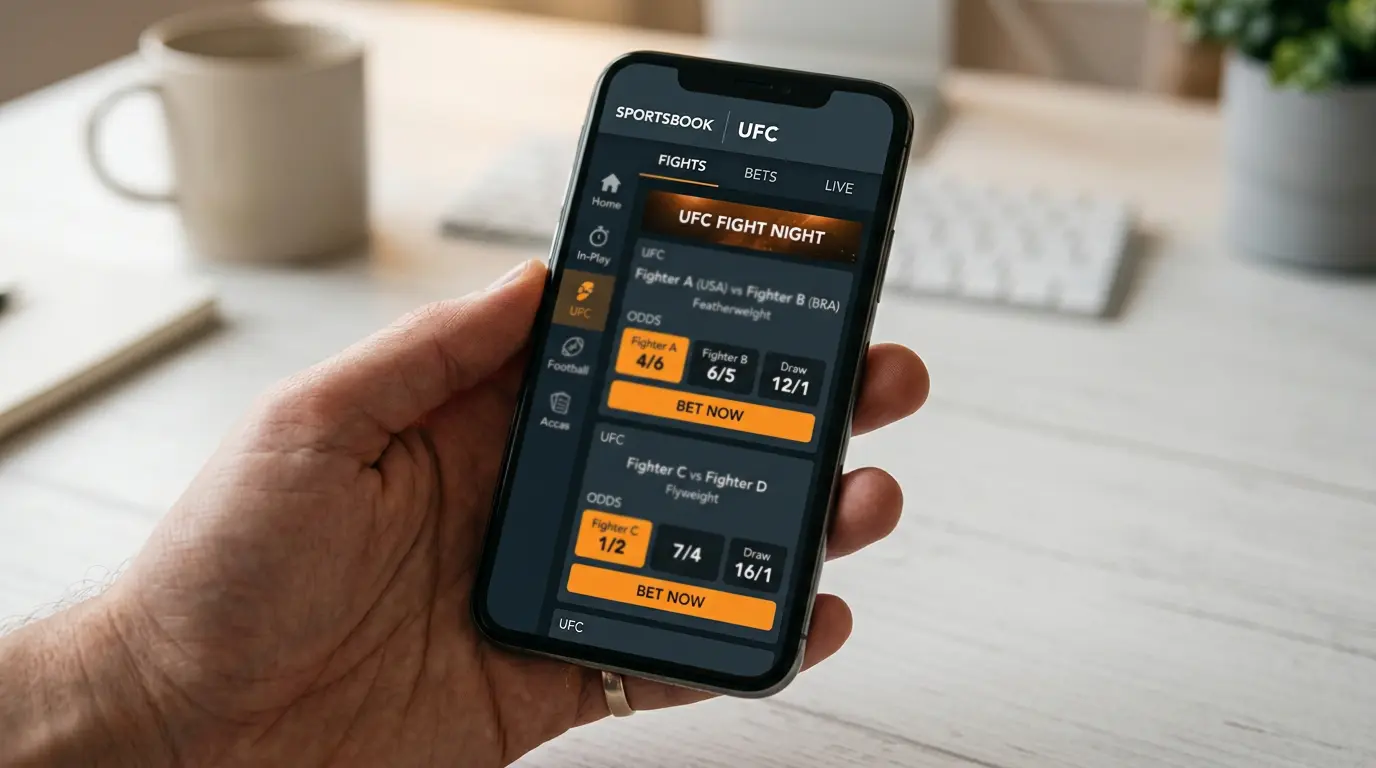
Every operator I mention is UKGC-licensed and offers UFC markets in the UK. I am not going to hand you a stack-ranked top ten. I am going to tell you what to look for, and where the differences between books actually show up on fight night.
Market depth, not market count
Every UK sportsbook advertises “thousands of markets” on UFC cards. That number is noise. What you want to know is how many markets the book opens per fight, how many of those are priced rather than listed, and whether the book has the nerve to keep lower-margin exotics open during the walkouts. Bet365, William Hill, Paddy Power, Ladbrokes, Coral, Betfair, Unibet, BetVictor and Betfred all offer the headline markets — moneyline, method of victory, round betting, totals, fight to go the distance. The gap shows up below that tier: time-of-finish bands, gone-in-60-seconds, both-fighters-knocked-down, takedown and significant-strike props. A book showing 180 priced markets on a co-main is not sharper — it is just willing to take thin-market action at 10%+ overround.
Fractional odds hide how far apart two prices really are. Enter the best and worst price you can find on the same fighter and the calculator converts the gap into the two numbers that matter: how much the break-even shifts, and what it does to a season.
| Price | Decimal | Break-even | £50 returns | Season result |
|---|---|---|---|---|
| Worst available | 1,667 | 60,00 % | £83,33 | £0 |
| Midpoint | 1,733 | 57,69 % | £86,67 | £400 |
| Best available | 1,800 | 55,56 % | £90,00 | £800 |
| Best plus a shade | 1,836 | 54,47 % | £91,80 | £1.016 |
The season figures assume a punter whose real hit rate sits exactly at the worse book’s break-even — in other words, someone with no handicapping edge whatsoever. That is the point worth dwelling on: everything in the right-hand column comes from clicking a different tab, not from reading a single fight better. Two comparisons put the size of it in context. First, the gap between these two prices is comparable to the whole margin a tight UK book charges on a main event, so shopping between books recovers roughly what a sharp operator would have taken from you anyway. Second, saving four points of break-even is a bigger swing than most bettors ever achieve by improving their fight analysis, and it requires no analysis at all. A note on the base rates quoted elsewhere in this guide. Short-price favourites at decimal 1,25 need 80,00% to break even, and the retention figure cited for that band is 88 to 93% — which would imply a substantial positive return on backing chalk, something that does not survive contact with a long sample. The likeliest explanation is that a band running from 1,25 down to 1,11 mixes prices whose fair rates differ by ten points, so the aggregate retention figure cannot be tested against any single price in it. Treat banded base rates as orientation, and test them at the specific price you are being offered. More in the guides to UFC odds and margin, implied probability and strategy. 18+, UKGC-licensed books only; National Gambling Helpline 0808 8020 133 and BeGambleAware.
Pricing discipline and margin
UK moneyline margins on UFC main events in 2025–26 sit in a band between roughly 3.5% and 8%. Call anything under 5% tight, 5–7% standard, and above 7% indicative of a book that is pricing for casuals. Undercard bouts carry wider margins — 6–10% is normal, and pay-per-view prelims can creep above 12%. Prop markets can run 15–25% overround without anyone raising an eyebrow. For the detailed maths on measuring margin yourself, read the guide to UFC odds in the UK.
Live pricing and latency
In-play odds on UFC fights update every 1–3 seconds at the faster books and every 5–10 seconds at the slower ones. A ten-second window inside a three-round fight is 1.1% of total scheduled fight time. The point is not to chase pennies — it is to understand that if you plan to bet in-play on UFC, the app is a tool and some tools are faster than others.
Bet Builder, cash out, acca insurance
The in-play toolkit is where UK books compete hardest. Bet Builders let you combine a fight-winner selection with method, round range, and totals within one fight, subject to correlation rules. Cash-out values are calculated from live odds with a house take of roughly 3–7%. Acca insurance varies wildly — some books refund stake as cash on a five-leg acca where one leg loses, others refund as a bonus token with rollover conditions that quietly erase most of the refund's value. More on that workflow later in this guide.
Streaming inside the sportsbook
UFC broadcast rights in the UK sit with TNT Sports, with premium cards priced at £19.99–£24.99 on TNT Sports Box Office and content also available through HBO Max in 2026. Inside a sportsbook app, streams are geo-locked to the UK and usually require a funded account or a qualifying bet. Latency tends to run a few seconds behind the linear feed. Treat streaming as a convenience, separate from pricing quality.
The integrity test
Here is the criterion almost no affiliate list mentions. On 1 November 2025, the Isaac Dulgarian versus Yadier del Valle fight at UFC Vegas 110 saw Dulgarian's price drift from about 1.40 to 1.77 while del Valle was hammered from around 3.00 down to 2.10 in the hours before the bout. UK-facing operators Caesars and William Hill voided the suspicious action. Others paid out normally. How a book handles that call tells you a lot about whose integrity desk actually works.
Evaluation framework: characteristics to check before opening a UK UFC account
| Characteristic | Tight standard | Acceptable | Avoid |
|---|---|---|---|
| UKGC licence | Held directly, number displayed in footer | White-label under licensed parent | No licence reference or offshore flag |
| Main-event moneyline margin | Under 5% | 5–7% | Above 8% |
| Priced markets per main-event fight | 60–120 with real liquidity | 40–60 | Fewer than 40 |
| In-play odds refresh | 1–3 seconds | 3–5 seconds | 10+ seconds |
| Bet Builder correlation rules | Published, predictable blocks | Standard restrictions applied | Opaque rejections after placement |
| Cash-out house take | Under 5% | 5–7% | Unclear, variable without notice |
| Acca insurance refund | Stake returned as cash | Free-bet token, low wagering | Bonus with heavy rollover |
| Integrity refund policy | Refunds all action, not just one side | Refunds proceed-side action with notice | No public policy, case-by-case silence |
| Deposit and withdrawal | Same-method, under 24 hours | Under 72 hours with verification | Reverse-withdrawal windows |
| Responsible gambling tools | Full GAMSTOP plus deposit, loss, session, reality-check limits | GAMSTOP plus deposit limits | Bare minimum only |
Run any UK UFC sportsbook against that grid before you deposit. Two books clearing every column is enough — you do not need accounts at nine places to line-shop effectively. You need accounts at two or three where margins, payout behaviour, and integrity posture all line up.
The best UK UFC sportsbook is not a brand. It is a combination of characteristics: UKGC licence, tight margin, deep but priced markets, fast in-play feed, transparent Bet Builder rules, clean integrity refunds. Measure two or three candidates against that list, then keep a line-shopping habit going on every card.
Reading UFC Prices the British Way
Ask an American punter what 11/4 means and watch the face. Ask a British punter what +275 means and you get the same blank stare. The UK is a fractional-odds country by default, and UFC markets on UK sportsbooks lead with fractions even though the underlying pricing engines speak decimal and the UFC broadcast graphics usually display American. You need to be fluent in all three, because line-shopping between two UK books sometimes means comparing 4/5 on one tab and 1.80 on another, and those are not the same number.
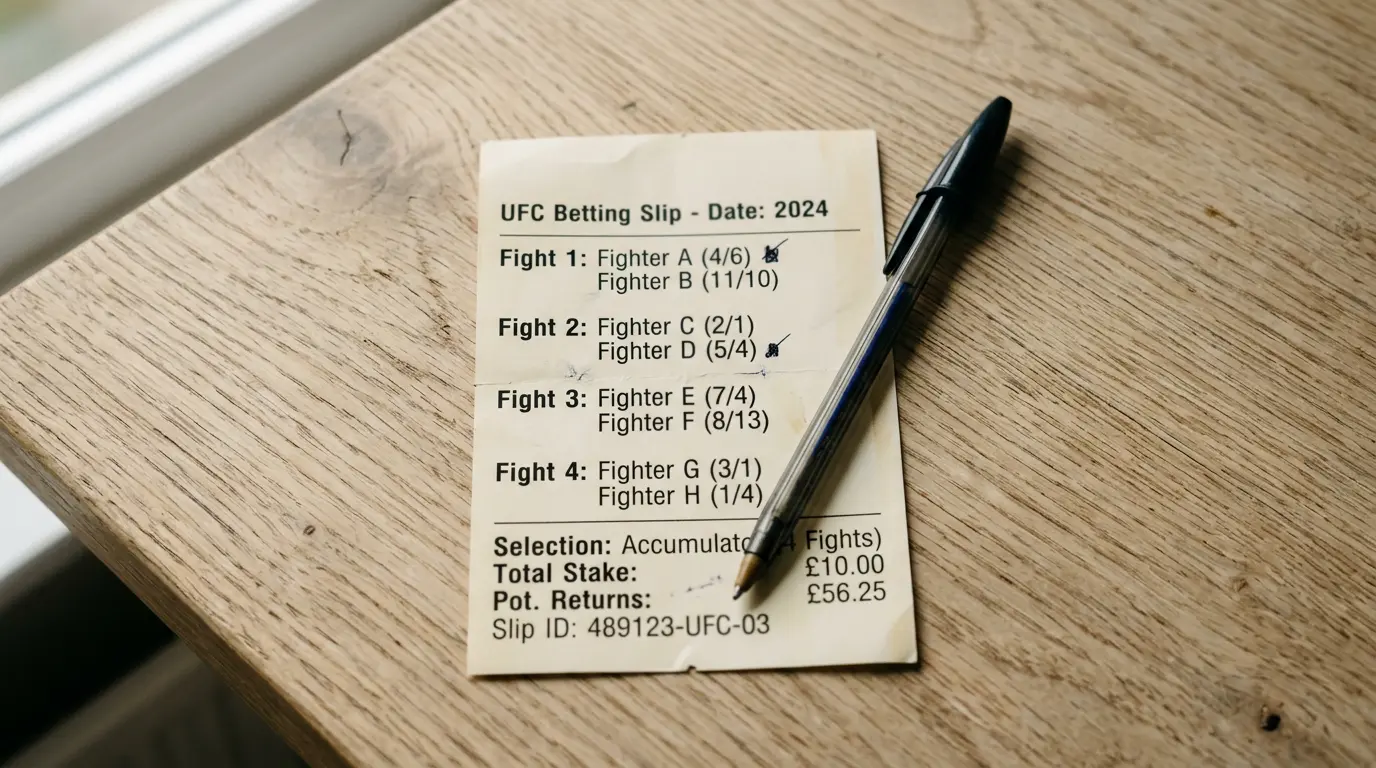
Fractional odds — the UK default format, written as numerator-over-denominator (for example, 4/6 or 11/4). The numerator is your profit, the denominator is your stake. A winning bet returns stake plus profit.
Start with fractionals because they are what you will see first. A price of 4/6 on a favourite means you stake 6 to win 4 — a £60 stake returns £100 total (£40 profit plus your £60 stake back). A price of 11/4 on an underdog means you stake 4 to win 11 — a £40 stake returns £150 total. Evens is written as 1/1, which means you double your stake. Anything shorter than evens — 4/5, 4/6, 4/9 — is odds-on, meaning the fighter is favoured to win. Anything longer — 11/10, 6/4, 2/1, 4/1 — is odds-against.
Converting UFC prices across formats — worked examples
| Fractional | Decimal | American | Implied probability | £50 stake returns |
|---|---|---|---|---|
| 4/9 | 1.44 | -225 | 69.2% | £72.22 |
| 4/6 | 1.67 | -150 | 60.0% | £83.33 |
| 8/11 | 1.73 | -137.5 | 57.9% | £86.36 |
| 1/1 (evens) | 2.00 | +100 | 50.0% | £100.00 |
| 11/10 | 2.10 | +110 | 47.6% | £105.00 |
| 6/4 | 2.50 | +150 | 40.0% | £125.00 |
| 11/4 | 3.75 | +275 | 26.7% | £187.50 |
| 4/1 | 5.00 | +400 | 20.0% | £250.00 |
Decimal odds are the format that every pricing desk in Europe actually uses under the hood. The conversion is mechanical. A fractional price of a/b converts to decimal as (a divided by b) plus 1. So 4/6 becomes (4 ÷ 6) + 1 = 1.67. The decimal figure already includes your stake — multiply the decimal by your stake to get your total return, not your profit. Most UK sportsbook apps let you toggle between fractional and decimal in the settings.
Implied probability is the single concept every UFC punter should internalise. A decimal price of 2.00 implies a 50% win probability, because 1 divided by 2.00 equals 0.50. A price of 1.67 implies 1 ÷ 1.67 = 59.9%, and 2.50 implies 1 ÷ 2.50 = 40.0%. Add the implied probabilities of both fighters in a two-way UFC market and you will get a number above 100% — the excess is the bookmaker's margin. On a main event priced at 4/6 and 11/10, that sum is 60.0% plus 47.6% = 107.6%, which is a 7.6% overround. The book's edge over a fair market is built in there. Stripping the overround back out — to find what the "true" price would be in a zero-margin market — is the foundation of value betting. And yes, it is tax-free for UK residents to do this profitably, though you will still pay the operator's margin in every transaction.
The UFC Markets That Actually Matter on a UK Sportsbook
There is a useful test I apply to any UFC card before I open a book. If I cannot explain in one sentence what I think is going to happen, I should not be touching the exotics — I should be on the moneyline, or I should be skipping the fight. Market selection is a discipline question before it is a pricing question. UK sportsbooks will offer you forty kinds of bet on any fight. Most of them exist because books are happy to take action on thin markets at fat margins, not because any of them represent your edge.
Moneyline (fight winner)
The backbone market. You are picking the winner, full stop. Settlement is on the official result — if the fight ends in a draw or a no contest, most UK books treat the moneyline as a void and return stakes. A handful still offer a three-way market with a draw option, though the price on a draw is terrible value on any two-way sport, let alone MMA where draws run below 1% historically.
Method of victory
Four primary outcomes are priced: KO/TKO, submission, decision, and — rarely, but it does appear — disqualification. A double-chance variant groups outcomes (for example "KO/TKO or DQ", "decision either way"). Method is where reading a fight carefully pays off more than on the moneyline, because you are pricing in style as well as winner.
Round betting
You pick the winning fighter and the round in which they win. A three-round bout gives six winning selections plus "goes to decision". A five-round championship gives twelve fighter-round combinations plus decision. Round betting is high-variance and high-priced, with typical prices on a specific round-one finish by a moderate underdog running 10/1 or longer.
Total rounds (over/under)
The totals line for a standard three-round fight typically sits at 1.5 or 2.5 rounds. The critical rule most newcomers miss: a round "goes over" the halfway mark only at the 2:30 point of that round. So "over 1.5 rounds" requires the fight to last past 2:30 of round two, not merely into round two. Alternate totals — over 0.5, 1.5, 2.5 — let you adjust the line if the main number looks priced.
Fight to go the distance
A simple yes/no two-way market. "Yes" wins if all scheduled rounds are completed and the result goes to the judges' scorecards. "No" wins on any finish — KO, TKO, submission, DQ, corner stoppage, doctor stoppage. Historically roughly half of UFC fights end inside the distance, so the prices cluster narrowly and the market becomes interesting only when you have a strong read on pace or stylistic mismatch.
Method and round combo
A combination market — fighter A to win by KO/TKO in rounds 1–2, fighter B by decision, and so on. The prices multiply the individual probabilities, so correlated combos (a knockout artist to win by KO) are shorter than the raw multiplication would suggest. Books build in the correlation, which closes some obvious edges.
Reading a method-and-round combo price
A fighter is listed at 4/6 moneyline. Method odds: KO/TKO 11/8, submission 11/1, decision 5/2.
Combo "fighter to win by KO in rounds 1 or 2" is listed at 5/2 — implying a 28.6% probability.
If the raw moneyline prices a 60% win probability and method prices a 42% chance of KO/TKO overall, naive multiplication gives 60% × 42% = 25.2%. The 28.6% priced figure reflects the book's view that KO is more likely in rounds one-two than in round three — correlation adjustment, not market error. Method-and-round combos with correlation baked in are not obviously beatable by simple multiplication.
Prop and exotic markets
Time-of-finish bands, gone-in-60-seconds, both fighters knocked down, total significant strikes, total takedowns, performance-of-the-night — the market goes as deep as a book is willing to price. Margins on props are wide because liquidity is thin. For most UK punters, props are entertainment rather than an edge — and the edge, if there is one, usually lives in the headline markets covered in the UFC betting markets handbook.
Settlement rules to internalise before fight night
A disqualification settles method-of-victory as DQ (if the market exists) or voids (if it does not). A no contest typically voids the fight across all markets. A fight cancelled before either fighter enters the cage voids all markets. A fighter withdrawn and replaced on short notice means the original market is usually voided and a new market opened at new prices — existing stakes are returned.
In-Play, Bet Builder and Cash Out: Where the UK Toolkit Earns Its Keep
The most interesting UFC bet I placed last year was a cash-out I did not take. A heavy underdog I had backed pre-fight at 5/2 was down on every scorecard after round one and the book offered me a cash-out at about 85% of my original stake — a decent hedge, the sort that looks sensible on paper. I held. He knocked the favourite out 40 seconds into round two. The cash-out would have crystallised a small loss; the hold paid out at full odds. That is not a morality tale about conviction. It is a reminder that the live toolkit exists to give you options, not to make the decision for you.

UK UFC in-play volumes are huge and skew aggressively mobile. 74% of UK in-play bets are placed from a phone or a tablet, and fight nights push that share higher because the action is short, the windows are narrow, and the desktop experience is overengineered for what amounts to a ten-second tactical decision between rounds. If you are not comfortable placing bets from an app, live betting is not your arena.
Three live tools matter on every UFC card. First, the in-play moneyline, which moves with damage, takedowns, and clock management. Second, the Bet Builder — a same-fight parlay combining moneyline, method, round, and totals legs within one fight. Bet Builders on UFC are more correlated than books' engines always price cleanly, and the occasional edge lives in the combinations a book flags as "available" but that its correlation model has not caught up to. Third, cash-out, which is calculated from the live odds with a house take of roughly 3–7% and suspends automatically when the market freezes during scrambles or damage events.
I am keeping this deliberately compact because the live-tools topic is deep enough to deserve its own full cluster. If you plan to bet UFC in-play regularly, go and read the full UFC live betting, Bet Builder and cash out workflow. There you will find the mechanics of partial cash-outs, the rules that block certain correlated Bet Builder legs, the acca insurance small print, and the latency comparison that matters on fight night.
Live-toolkit red flags on a UK sportsbook app
Markets that suspend for more than 10 seconds at a stretch during a stand-up exchange without meaningful damage — the book's pricing engine is probably behind the feed. Cash-out prices that jump unfavourably by more than 10% without a visible in-cage event. Bet Builder selections silently rejected after you tap "place bet". Push notifications offering odds boosts that disappear before you can tap through. Any of these on a regular basis is a signal to move accounts, not to persist.
The 2025 Regulatory Reset and What It Changed for UFC Punters
Here is a question I get asked at least once a week. Does the £5 stake limit that came into force in April 2025 apply to my UFC moneyline bet? No. It does not. And understanding why matters, because the 2025 UK gambling reforms landed in a way that was reported in the press with enough sloppiness that a generation of UFC bettors think they are capped when they are not.
The UK gambling industry is genuinely large and genuinely regulated. Total Gross Gambling Yield was £16.8 billion in the year to March 2025, up 7.3% on the prior year, and the online sector specifically rose to £7.8 billion, up 13.1%. Those numbers sit inside a regulatory frame redesigned across 2024 and 2025 to lean harder on consumer protection without — and this is the key point — changing how sportsbook markets on events like UFC are structured day to day.
UKGC licensing
Every UK-facing operator taking UFC bets from a UK resident must hold a remote operating licence from the UK Gambling Commission. Licensed gambling premises in the UK sat at 8,234 in March 2025, down 1.1%, with betting shops at 5,825. Retail is contracting while online operator counts hold steady. Any book's licence status is verifiable on the UKGC public register, and the operator is legally required to display its licence number somewhere visible on its UK-facing site. A book that cannot produce a licence number on request is not a UK book.
The 2025 stake limits — what they actually cap
From 9 April 2025, a statutory £5 maximum stake per spin applies to online slots for players aged 25 and over. From 21 May 2025, a £2 maximum per spin applies for players aged 18 to 24. Both limits came via The Gambling Act 2005 (Operating Licence Conditions) (Amendment) Regulations 2025. Neither applies to sportsbook markets. Your UFC moneyline, method of victory, Bet Builder, totals, live bet, acca, or futures stake is not capped by statute — it is capped only by the operator's own internal risk rules.
Stephanie Peacock MP, the Parliamentary Under-Secretary at DCMS, explained the age-tiered limit by pointing out that younger people may be at elevated risk of gambling harm and that young adults aged 18 to 24 have the highest problem gambling rates of any age group. That framing — age-tiered, product-specific — is why the caps target slots, not sports.
The statutory gambling levy
From 6 April 2025, the Gambling Statutory Levy — introduced under The Gambling Levy Regulations 2025 — applies to operators at a rate between 0.1% and 1.1% of Gross Gambling Yield, scaled by sector. Remote casino, betting and bingo operators are in the middle of that band. The levy is ring-fenced for research, prevention, and treatment of gambling harm. Gambling Minister Baroness Twycross noted that online slots are the fastest-growing gambling product and that yield has grown by 61% over the past five years, which is the context in which the levy is sized.
"Gross Gambling Yield for the industry was £16.8 billion in the year to March 2025, which represents an increase of 7.3 percent since last year. This rise has largely been driven by GGY generated from online gambling which has gone up by more than £900 million to an annual figure of £7.8 billion." — Jason Davies, UKGC
The practical read: the levy falls on the operator, not on you. It does not change the odds you see, stake limits on sportsbook markets, or the tax treatment of winnings. It does change operator economics, and for the full detail on how the 2025 rulebook maps onto UFC betting — stake caps, levy, integrity, tax, safer-play — see the UK UFC betting regulation guide.
What 2025 changed for a UK UFC punter
Sportsbook stake limits on UFC: unchanged. Age threshold for betting: unchanged at 18. Winnings tax treatment: unchanged — still tax-free for UK residents. Operator-side costs: up because of the levy, with no automatic pass-through. Advertising rules: tightened, with 72% of gambling TV ads already airing after the 9pm watershed in 2024. Self-exclusion: GAMSTOP remains the cross-operator tool of record.
Integrity, the Dulgarian Precedent, and Why Refunds Reveal Character
I remember the Dulgarian screenshots bouncing around my group chat on the morning of 1 November 2025. A line moving from 1.40 to 1.77 on one fighter while his opponent crashed from 3.00 to 2.10 is the sort of pattern that either means a catastrophic injury leak nobody published, or it means something worse. The result was worse. On 3 November, UFC publicly confirmed that IC360 — the integrity service UFC has worked with since 2023 — was reviewing the Dulgarian versus del Valle bout. Dulgarian was released by the promotion. UK-facing operators Caesars and William Hill voided the action. Others did not.
"UFC works with an independent betting integrity service to monitor wagering activity on our events. Our betting integrity partner, IC360, monitors wagering on every UFC event and is conducting a thorough review of the facts surrounding the Dulgarian vs. del Valle bout. We take these allegations very seriously, and along with the health and safety of our fighters, nothing is more important than the integrity of our sport." — UFC statement, 3 November 2025
Dana White's response to TMZ Sports was less diplomatic and more instructive about the enforcement posture.
"The first thing we did was call the FBI. I've met with the FBI twice today. If you try to do this, we will be your worst enemy. We will immediately go after you with the FBI." — Dana White, CEO of UFC
Two things about the integrity framework you should know before you place a UFC bet. IC360 has been generating a betting report on every UFC fight since 2023, and UFC since 2023 has banned all fighters, coaches, and managers from betting on its events. The Dulgarian case was the second major integrity incident in three years — the first being the 2022 Darrick Minner / James Krause episode, which re-shaped how the promotion handles suspicious line movement.
The part that practically affects your bankroll: when a book refunds suspicious action, it refunds the proceed side — the action that benefitted from the leaked information. Some UK operators refund both sides as a cleaner policy. Others refund one side and let the other ride. Neither is legally required; both are permissible under current UKGC guidance. What you care about as a punter is knowing in advance which side your book falls on, because the difference shows up as a real ledger hit when it happens to you.
UFC claims 700 million fans globally and 330 million social media followers. IC360 monitors wagering across events that touch all of them. Genuine fixes are rare; visible attempts, as Dulgarian showed, are increasingly caught.
The integrity question should inform which UK books you hold accounts with, not which fights you bet on. Check each candidate's refund policy before you deposit, not after a Dulgarian-shaped event lands on a Saturday night.
Watching What You Bet On: UFC Broadcast in the UK
The honest answer to "can I watch the fight I just bet on" is: usually yes, though probably not the way you expect. The UFC broadcast landscape in the UK is layered — free to air, subscription, pay-per-view, and in-app sportsbook streams — and the layer you end up on depends on the specific card.

TNT Sports has held the UFC broadcast rights in the UK and Ireland since 2013, back when it was BT Sport. The last renewal came in May 2022 and runs through 2026, with content now also accessible through HBO Max as part of the Warner platform consolidation. Routine Fight Night cards are included in a standard TNT Sports subscription. Premium cards — the numbered pay-per-view events like UFC 324 and onwards — are sold separately through TNT Sports Box Office at £19.99–£24.99 per card in 2025–26. In Ireland, the same cards price at €29.99.
The 2026 commercial environment is worth understanding because it affects everything downstream, including UK betting partnerships. UFC signed a seven-year deal with Paramount+ for US rights in August 2025 at an average annual value of $1.1 billion — a number that reshuffled the promotion's strategic calculus and triggered the ripple effect that saw Bet365 replace DraftKings as UFC's official sportsbook in North America in March 2026 under a five-year global partnership.
In-app streaming inside UK sportsbooks is a separate question. UKGC-licensed books that offer UFC streams typically gate access behind a qualifying deposit or a funded account with recent activity. The stream sits a few seconds behind the linear TNT Sports broadcast because the data chain is longer. Treat the in-app stream as a convenient second screen, not a replacement for the main broadcast.
UK UFC broadcast quick reference
Routine Fight Night cards: included with TNT Sports subscription; also available via HBO Max in 2026. PPV cards (UFC 324, 325, and onwards): £19.99–£24.99 per card on TNT Sports Box Office. In-app sportsbook streams: UKGC-licensed books only, typically gated by funded account, latency of a few seconds behind TNT. Prelims often broadcast on UFC Fight Pass, a separate subscription from the main TNT deal.
A Strategy Primer Grounded in Actual UFC Outcome Data
Most strategy content in this niche is written as if the author has never taken a bad beat. I have taken plenty. The honest version is that UFC betting is a long game where small edges, disciplined staking, and saying no to bad cards matter more than being clever on any individual fight. Three numbers from the historical record anchor the whole approach.
First, the underdog win rate. UFC underdogs cash roughly 30–35% of the time — around 32% through 2023–24 on samples I track, with other long-run estimates near 35%. That is not a licence to bet every dog; it is a reminder that the market is not mispricing the favourite in your direction as often as you think.
Second, the favourite retention rate at short prices. UFC favourites priced at decimal odds between 1.25 and 1.11 — roughly -400 to -900 in American terms — have won 88–93% of the time since 2013. If you are backing a chalk favourite at 1/5, the book is not far off fair, and the cost of being wrong is steep relative to the payout.
Third, the underdog-champion retention rate. In UFC history, underdog champions — fighters entering a title defence priced above evens — have retained in 12 of 19 recorded cases, or 63%. That is a real edge worth pricing into rematches and title-fight contexts where the narrative leans toward the more exciting challenger.
One more: among UFC rematches, the winner of the first fight wins the second in roughly 66% of cases — historically around 52 wins to 26 losses. The narrative arc of a rematch features "lessons learned" and "adjustments made", but the base rate says the first fight is more predictive of the second than the story suggests.
[✓ Do]
- Line-shop across two UKGC books on every bet — a 5% better price compounds meaningfully over a year.
- Flat-stake until you have a documented 200-bet sample at whatever unit size you started with.
- Track closing line value — if you are consistently beating the close, your process is sound even when results are not.
- Skip any card where a main-event fighter has missed weight badly or stepped in on under ten days' notice.
[✗ Don't]
- Bet every fight on a prelim card because you have "done the research" — prelim margins are wider and variance is higher.
- Chase losses by stepping up stake size mid-card.
- Assume you have beaten a correlation model on a Bet Builder — the model has seen the same combos for a decade.
- Treat a streak of four or five winning picks as evidence your edge is real. It is not a big enough sample.
Paddy Pimblett, the Liverpool lightweight ranked #6 in the division, told Sky Sports in January 2026, "I think the odds are going lower and lower. It would be a shame, obviously, but I don't think anywhere is big enough [in the UK], unless they come to Anfield — that's the dream." Active fighters track their own prices too.
The point of carrying these base rates around is not to apply them mechanically. It is to know what the prior probability looks like so you can tell when a specific matchup is asking you to deviate from it. The UFC betting strategy guide is where the numbers turn into a process.
Betting Within Limits: The Responsible-Play Layer
A friend of mine stopped betting UFC for two years after a Saturday night where he watched the main event on a TNT feed while refreshing a cash-out offer on his phone and realised he could not remember which fighter he had backed. He had bet three times on the same card, was up on two and down on one, and the part that bothered him was not the ledger — it was that the enjoyment had drained out of watching the fight. He called the National Gambling Helpline that Monday, set a six-month GAMSTOP exclusion, and came back with harder rules. That is not a cautionary tale; it is a realistic outline of what the tools are for.
Lord Foster of Bath put the scale of the issue plainly in the House of Lords debate on the levy regulations in February 2025.
"The latest data shows that gambling harm in the UK directly affects 2.5% of the adult population. This means that over 1.5 million adults in the UK struggle with the public health effects of gambling addiction." — Lord Foster of Bath, 12 February 2025
Those numbers — 2.5% of adults, 1.5 million people — are not a statistical curiosity. They are the policy anchor for the entire 2025 reform package. The NHS estimated the annual cost of gambling harm in the UK at £1.2 billion, set against £3.1 billion of tax revenue for a notional net fiscal contribution of £1.9 billion. Treatment demand has grown too: NHS referrals for gambling disorder rose 34% between 2019 and 2024.
Every UKGC-licensed sportsbook in the UK is required to offer a core set of player-protection tools. Deposit limits — daily, weekly, or monthly — can be set in the account settings and cannot be increased without a cooling-off period. Loss limits operate similarly. Session time limits and reality checks push a notification into your app at whatever interval you set. Self-exclusion through GAMSTOP blocks your details across every UKGC-licensed operator for a minimum of six months, with twelve-month and five-year options also available.
If you need support now
The National Gambling Helpline runs 24/7 on 0808 8020 133 (freephone in the UK). GamCare provides live chat and treatment referrals. GAMSTOP (gamstop.co.uk) handles self-exclusion across UKGC books. Deposit limits and reality checks sit in every UKGC sportsbook's account settings and take effect immediately, with cooling-off periods required before any upward adjustment.
Questions UK UFC Punters Keep Asking
Is it legal to bet on UFC in the UK?
Yes. Betting on UFC events is legal for UK residents aged 18 and over, provided the sportsbook is licensed by the UK Gambling Commission. Every operator taking UFC bets from UK customers must hold a remote operating licence, and the licence number is legally required to be displayed on the UK-facing site. If a site offers UFC markets without a visible UKGC licence, it is not a UK book and you have no UK-regulator recourse if something goes wrong.
Which UK bookmakers offer the best UFC odds?
There is no single "best" UK UFC book and I am not going to pretend otherwise. Main-event moneyline margins across UKGC-licensed operators range from under 5% at the tightest to above 8% at the softest, and which specific book is sharpest on any given card varies. The practical answer is to line-shop across two or three accounts rather than commit to one. If a book consistently prices main events under 5% overround, they are a serious operator on UFC.
Do UK bettors pay tax on UFC winnings?
No. Gambling winnings — including UFC bets — are not subject to income tax for UK residents. The UK operates a point-of-consumption duty model, which means the operator pays duty on the bet, not the customer. This applies regardless of stake size or profit level for ordinary recreational bettors. For almost everyone reading this, winnings are tax-free and do not need to be declared on self-assessment.
What is the minimum age to bet on UFC in the UK?
18. UKGC rules set the legal age for gambling — including sportsbook bets on UFC — at 18 for all regulated products. Operators are required to verify age at account opening. The 2025 reforms introduced a lower £2 per-spin stake limit on online slots for players aged 18–24, but that limit applies to slots only and does not affect UFC sportsbook markets, which have no statutory stake cap.
Can I watch the UFC fights I have bet on in the UK?
Usually. Routine Fight Night cards are broadcast on TNT Sports, available through a subscription and also via HBO Max in 2026. Numbered pay-per-view cards are sold separately on TNT Sports Box Office at £19.99–£24.99 per card. Several UKGC-licensed sportsbooks offer in-app UFC streams, typically gated behind a qualifying deposit, with a small latency lag versus the main TNT feed. Prelims sometimes air on UFC Fight Pass, a separate subscription.
What is the difference between moneyline, fractional and decimal UFC odds?
Moneyline is the market — you are betting on the winner of the fight. Fractional and decimal are display formats for the same price. A UK book shows 4/6 by default; the same price in decimal is 1.67 and in American format is -150. Fractional shows profit over stake (4 profit on 6 stake). Decimal shows total return per unit staked (a £10 stake at 1.67 returns £16.70 total, £6.70 of which is profit). Implied probability is the same price as a percentage — 1 divided by 1.67 equals about 60%.
How do I pick between Bet365, William Hill and Paddy Power for UFC?
Run the same fight through all three on a Saturday morning and compare the main-event moneyline prices, the number of priced markets on the undercard, the Bet Builder offerings, and the cash-out values. Whichever book is consistently sharper across the full card is the one to use for that card — and that book is not always the same across events. Rather than picking one, open accounts at two and treat them as a line-shopping pair.
A Scoreboard, Not a Podium
The question that opened this guide — where is the best place to bet on UFC in the UK — sounds like it wants a single answer. It never does.
The best UK UFC sportsbook for you is not a brand name on a top-ten list. It is whatever combination of two or three UKGC-licensed operators gives you tight main-event margins, a deep but priced market board, fast in-play odds, transparent cash-out maths, clean integrity refunds, and responsible-play tools that actually work when you set them. The numbers that should anchor your decisions — 30–35% underdog win rate, 88–93% short-price favourite retention, 66% rematch repeat rate, 74% of in-play action on mobile, 2.5% of UK adults affected by gambling harm — are the real scoreboard. Run your books against them, run your own bets against the same data, and line-shop on every card that matters. That is not glamorous advice. It is the advice that survives contact with a bad Saturday night.
Created by the ”Best Place to bet on ufc” editorial team.